Showing posts with label JMC163. Show all posts

Tuesday, March 06, 2007

Coming Back from the Flu; Vlogging, and JMC163

I'm finally back to blogging and school after a week off with a nasty case of the flu. Thanks to my teachers for being understanding.

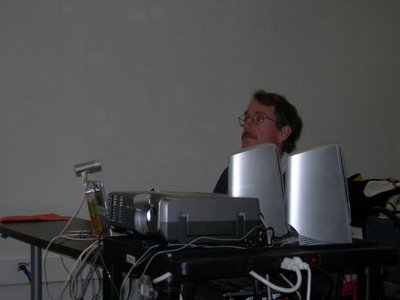
Tonight I'll be speaking at Steve Sloan's JMC163 at 6:00PM, with an intro into vlogging and video-editing. Fun stuff, and even more fun when lots of other people you know are doing it too.

ASIDE: This is the reason I haven't had cable TV for the last year. Aren't all the networks online now anyways? Minus, of course, Fox. (24!)

I've been hearing good things about the class, as a few of Steve's students have also attended STEM meetings. (There's another meeting tomorrow at 4:30, Academic Success Center, Room 116...FYI)

Well, that's enough for excuses and blatant plugs - here's some current events.


The Spartan Daily had this article today about the use of podcasting in classes at SJSU.


The political end of blogosphere is going CRAZY over the result of the Libby trial.


And Wikipedia may be in the mist of a drastic change of policy. Why is this important? Because, like it or not, Wikipedia has become a major media gatekeeper - people read Wikinews, study from Wikipedia, and more and more, live in a Wikiverse.

, , , , ,,, ,,,,,
, , ,

Wednesday, December 13, 2006

The Emperor 's New Tags

JMC163 is now over. The University will dismantle its current form, regardless of student objections. The troubling circumstances of its demolition have given me pause though, and in turn, I would like to share a little insight I have gained through my experiences. I admit, I am only a young student, but wisdom can sometimes come from the oddest places.

It seems to me that attention must be paid to WHY the University hasn't made palpable strides towards modernizing its journalism curriculum since the introduction of Broadcast as a concentration.

For starters, the pace at which technology has shifted the media landscape has been exponential. And just as government is insular and slower than public markets to innovate, so too is faculty slower than masses of students with free access to educational information.

Teachers have become insular with regards to HOW they teach, with command style, top-to-bottom methods favored in the classroom. This is not at all meant to offend. In fact, this methodology has not only been the dominant style of teaching for hundreds of years, it has been the most efficient. Until now.

The problem that pre-internet civilization encountered with regards to teaching was that which nations encounter everyday fighting famine. It's a simple matter of distribution, not production capabilities.

IE1. As in the United States, production of food is so great that if one were to simply look at production rates and capabilities, they would be forced to conclude that there is no reason for Americans to be missing meals or starving. Still, Americans do go without food, because the markets and government together cannot provide them with a price that is reasonable enough to guarantee they eat three meals a day. Distribution is limited, not food.

IE.2 With a scarce amount of knowledgeable, certifiably qualified individuals able to distribute information that students craved, tribal students faced the same dilemma. Students, hungry for education, could not afford to travel between tribes to find individuals to educate them in specific disciplines, leading to a lack of educated individuals. So they instead were forced to learn general knowledge, common to the people that were readily available to them. Because of this, distribution of knowledge was limited, as was the rate at which economic production increased.

The solution to this distribution problem was to centralize learning in a stationary location. Ergo, the modern grammar schools, high schools, and Universities (I will continue with only the evolution of the University for the purposes of this post). This maximized learning efficiency given the technologies at hand, but did satisfy the market desire for education. Potential students still went without education because the distribution of knowledge was limited to those that could afford to attend the University, and then only if the University itself had enough money to aggregate great thinkers.

Flash forward to post-internet, wired American society; private markets have side-stepped the inefficiencies of the old educational system and physical world, creating unlimited FREE learning distribution tools previously unaffordable or unattainable because of distribution scarcity. In reality, distribution scarcity for wired students now exists only insofar as knowledge of the resources already available is unknown to students, and insofar as their personal understanding of the knowledge.

This is where the University not only still has a place, but an obligation to step in. It is as drastic a paradigm shift as it was for students being educated by their tribal elders to go from the comfort of their small communities to central Universities. It is as far-reaching as the impact that the written word had on the ability to distribute ideas, and it is as essential to the future of education as the evolution of vocal chords was to enabling individual freedom.

THE SHIFT IS FROM THE COMMAND STATION TO THE NODE. Wikipedia, OurMedia, Google, Technorati, Firefox, SourceForge, iTunes, OPML, XML, mesh-networks, these are the tools and language of the current paradigm shift. They enable the free distribution of any and all information from node to node, without prejudice as to creed, color, religion or age. And to top it all off, they do so with the efficiency of the private markets. Yet many of them are unknown to students, and teachers.

Teachers - as a group, the Emperor of the educational system today - so revered and established in the method of education, that no person today is considered "educated" without certification from them!

Today, the Emperor for the most part, lacks general knowledge of the new paradigm, or its ability to decrease distribution scarcity. Generally, the Emperor does not blog, does not submit videos to YouTube, know Flash, scour MySpace, Digg, host wikis, indulge his curiosity for alternative methods of teaching, or tag. The Emperor has no tags!

How shameful it must be to finally realize that without "tags", or knowledge of the new paradigm, the Emperor's shortcomings and inefficiencies are now exposed! Yet the Emperor today marches on, after having been warned of the truth. He cannot say he wasn't warned.

THIS IS THE EMPEROR'S WARNING: HE IS NAKED FOR ALL TO SEE.

So what can the Emperor do to save face, to be the great Emperor all students once revered? For starters, he must begin using the tools of the new paradigm to become educated ABOUT them. In so doing, the Emperor must also improve upon them were his expertise and vast knowledge apply, making the interface between the user and the database as efficient as possible. Remember, the new paradigm is uer-generated; the Emperor must become a user!

This is only the first step though. After learning the tools and improving upon the base of online knowledge, the Emperor must accept that his place in the hierarchy has forever been altered, and must use the new tools to teach students to do as he has done.

Only then, when the Emperor has tags - when teachers have accepted the new paradigm instead of fighting against the avalanche that it inevitably will become - will education again be "modern". Only then will students be given the education they crave, and only then will children like me not have any reason to point and shout at how foolish we all have become.


Friday, December 08, 2006

JMC163 got onto Wordpress' "Blog of the Day" list

Well I'll be. I missed it when it happened, by apparently JMC163 got onto Wordpress' "Blog of the Day" list for growing blogs on November 23rd. Cool.

Monday, December 04, 2006

The Student Manifesto

(I just submitted this to the Spartan Daily Blog. I hope they allow it on the site.)

The Problem


This will probably turn into a master's thesis, but here it goes. For the future of SJSU, I hope the administration is reading.

Disclosure: I am a student in JMC163, the New Media Class taught by Cynthia McCune and Steve Sloan. It would be an understatement to say the class has been successful. In reality, it has drawn the praise of countless blog-readers, authors, and webzinites from several countries.

This is why I was so surprised when Steve Sloan announced on his blog that the University is planning to reshape the class into a more technical course on InDesign, Photoshop, and Dreamweaver.

If you remember from the article in the Spartan Daily or the San Jose Mercury News, Steve Sloan and the bloggers from JMC 163 were the leading forces behind the push to keep Skype on campus at SJSU.

We drew the attention of people as far away as Indonesia. Robert Scoble blogged about us several times. A photographer from the Chronicle of Higher Education even sent a photographer for an article written on the class. And that's just the tip of the iceberg. I could go on and on.

With all the positive feedback and praise, why then would the University consider dismantling the class? Good question. But I digress...

What Have We Learned in JMC163?

First off, InDesign, Photoshop, and Dreamweaver are all important programs to learn. No student in JMC163 would say otherwise. But the current class is not technical, nor is it designed to be. The fundamental question it poses to students, "WHY is New Media important," is far more crucial to our futures than the tools we need in today's markets.

Instead of technical expertise, for the most part we study the trends and causes that have pushed the decline of print news and the rise of online markets, while experimenting with social networking, blogging, and metaverse traversing, as a way to understand the concepts of New Media.

To put it another way that fellow journalists might appreciate, we assume that the acquisition of true understanding cannot be supplemented by technical skills - true education cannot exist without fundamental understanding - understanding, itself, is the motive that drives us to learn the technical skills we need.

Therefore, it is to the detriment of students that the opportunity to gain insight into WHY the world works as it does may be taken away by the University. Any reasonable mind can figure out Photoshop in a day or two, or spend a couple hundred bucks and a weekend to get certified.

How often do you get to Skype David Weinberger, co-author of the Cluetrain Manifesto (one of our course books), or to interview Phil Wolff, A-list blogger from Skype Journal? How often are you lectured from Ryanne Hodson, from Node101, or from Steve Sergeant of WildeBeat?

Cluetrain Manifesto and The World is Flat are our course readers.

Some critics have stated that there's isn't a future for Web 2.0 technologies and New Media in the journalism industry. The explosion of online journalism, citizen journalism, and leaks to bloggers discredits this argument though.

Others have said that without the proper tools (InDesign, Photoshop, and Dreamweaver), a basic understanding of New Media will come to nothing. I agree.

What We Should Do: A Solution

I propose a complete overhaul of the journalism curriculum at SJSU, starting with the development of New Media as a concentration. Print and Broadcast are fast becoming niche markets as consumers more often than not are reading hard print and watching the TV AFTER already seeing or reading it online. The Long Tail is gaining a larger viewer and readership than traditional media.

It is true that we need specific tools, but we also need theory and core journalistic values. A core GE specifically for journalists must be established, which should include an introduction to Dreamweaver, InDesign, and Photoshop, as well as stressing objectivity, fairness and truth-seeking.

After completion of this GE, journalism students should be able to concentrate in Print, Broadcast, or New Media.

In this new concentration, students could then delve into the concepts and software that make Web 2.0 technologies, podcasting, and vodcasting work.

What We Lose By Waiting

The media markets are rapidly evolving, and SJSU does not currently equip journalism students with the skills and understanding they need to compete. As the world progresses with more digital enterprises, SJSU risks not only losing its edge in the technology markets by failing to offer such courses, but its image as a leader in innovation.

Silicon Valley was built upon progressive thinking; the need to think critically and restructure antiquated paradigms has never been greater. The risk for not acting soon to ensure our competitive advantage in the new media world far outweighs the cost of providing extra classes to students.

For the future of the valley's economy, SJSU, and its students, I strongly urge the University to keep JMC163 as it is, and to rethink the role of New Media in education.

Thursday, November 30, 2006

Well, that about sums it up...

Let no one ever say he didn't say it like he saw it. Go Steve.
[The following is a repost from Steve Sloan on his website, SJSU Tech on a mission, on 11.29.2006]


Editorial: The evil of opacity

What we would like to do, may not be what we can do (and maybe that is okay)
That is just a fact of life. We learn as kids, "if wishes were horses then beggars would ride." Sometimes it is easy to just keep our wants and needs to ourselves. But, when it comes to what we want and need as a university, I think openness is better than being closed. I think we need to be more open about what we need, we should put it out there, rather than use the lack of resources as an excuse.

There is also the matter of allocation of the resources we do have. If folks are engaged in the thought process I think they are more likely to help us. I think we need to openly talk about where we see our school going and our vision of the future. I think we need to be free to do this as individuals as well as an institution. I think we need to have open conversations in a way that engages our colleagues, our partners and also our customers, the students. I believe our customers deserve more respect. I think our other customers, the public, deserves to engaged, after all, they pay our salaries. They are taxed to pay our salaries.

SJSU is a public state funded university. I see it as being paradoxical that we public servants are performing our public services spending the taxpayers hard earned money and yet we see it as the right thing to do to be opaque. New media is all about transparency and conversation. But, from what I see, that seems counter to a university culture of closed doors, politics, secrecy and overall opacity.

To me that opacity is not right, it is evil, and maybe that is why I seem to be so good at getting in trouble when I state my opinion. I may be wrong often and readily admit when I am wrong. There are worse things than being wrong. I think if you are open about your intentions and you are wrong and someone points that out you have an opportunity to change for the better. But, I think if you exist in a world of shadows and you are wrong that is worse; because then your mistakes remain hidden they never have an opportunity to be amended. I would rather risk being openly wrong than have to be secretly right knowing my ideas will never see the light of the day.

I love my school and I think we should express our ideas and opinions, consider those of others and speak out about our feelings and embrace the collective intelligence of all those great folks who care about us enough to engage in a conversation constructively. That is why I love blogging and all the other forms of new media. It is based on the Internet and the two basic concepts of the Internet: the Internet routes around obstacles and enables communication to all nodes from all nodes. How does the Internet do this? It does that because on the Internet all nodes are equal. On the Internet all nodes are free to communicate.

, , , , ,, , , ,

Wednesday, November 29, 2006

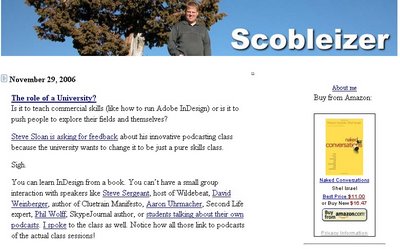
Scoble Writes on JMC163

Robert did this piece today on Steve Sloan's announcement that the University may dismantle what is now JMC163. He wrote:

Sigh.

You can learn InDesign from a book. You can’t have a small group interaction with speakers like Steve Sergeant, host of Wildebeat, David Weinberger, author of Cluetrain Manifesto, Aaron Uhrmacher, Second Life expert, Phil Wolff, SkypeJournal author, or students talking about their own podcasts. I spoke to the class as well. Notice how all those link to podcasts of the actual class sessions!

It’s a shame, because San Jose State University needs more innovative classes like these, not fewer.

Amen. The post has gotten quite a few comments from people that visit his site, most of them supportive of the current class.


I said it once and I'll say it again, the University needs to revamp its curriculum and consider making New Media a concentration unto itself. What's happening now is essentially like having all Nursing and Biology students in the same major because it might increase costs to the school to have both.

That's a backward way of thinking; new programs that entice students to use specialty skills to broaden markets and generate revenue (or God help us, further free-speech) are a DRAW TO THE UNIVER$ITY.
But like Ryan Sholin commented yesterday, "...it won't happen until they [the University] completely revamp[s] the curriculum. And good luck on that one."

Sigh.

, , , , , , , , , , ,,

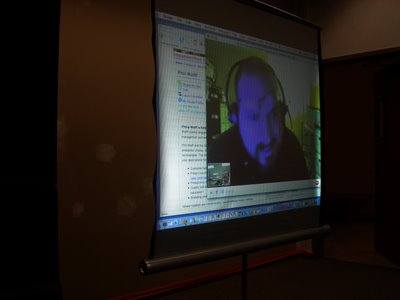
Phil Wolff Skyped JMC 163 Last Night


The blogger from Skype Journal wasn't the only one stopping by to say hi; Fred Mertz, a freelance photographer working for the Chronicle of Higher Education, also stopped by and took pictures for an upcoming piece on JMC163.

Wolff talked a little bit about the Skype story at SJSU that took place earlier this year. He dissected it, sharing why he believed the story took off the way that it did. What were the points he talked about?
1.There were local advocates with a vested interest in keeping Skype on campus.
2.The blogosphere picked up the story and turned it viral.
3.The traditional media picked it up as well.
4.It already had all of the elements of a good story: power struggle, work being affected, and a school environment.

Verdad.

I'll keep you posted on the Higher Ed piece when it comes out. It will most likely also be talking about the Skype piece a bit. The ironic part about this whole thing is that the very class that has attracted so much attention for the great job that it has done may be dismantled by next semester.

Steve Sloan posted a disturbing piece on his personal blog Tuesday:


There is a plan to turn 163 partly into a software teaching class and teach InDesign, Photoshop, other applications and maybe half a semester’s worth of “new media.” This will be a real change in what has become known as, “the podcasting class.”

I have nothing against the Adobe Creative Suite applications, I use them and have taught them. But, I do not see this as being consistent with what we are doing in this class. This semester 163 has concentrated on the Internet and emerging forms of journalism. Maybe I am wrong.

We have a meetup on Thursday November 30 at 7pm in downtown San Jose at Tony Soprano’s Pizzeria. You are invited to come or comment. I would love to get input from folks on this subject. I know our accreditation limits the amount of units we can do new stuff with. But, I see this class as being critical.

I'm not thrilled by this development at all. As has been mentioned by several students in JMC163 and professionals outside the class, classes on Photoshop, InDesign, Dreamweaver, and other apps can been taken very easily for a few hundred bucks over a weekend. The understanding of WHY new media is taking off and WHERE it is going is much more pertenant to our future careers.

If the University really wants students to learn those programs, then they should consider making New Media a concentration like Print and Broadcast are. Removing such vital content will only act as a disservice to students.

And maybe it's just my journalism background speaking, but I think journalists SHOULD be more interested in the WHY than the HOW, because the HOW is always conditional upon the WHY.

, , , , , , , , , , ,,

Sunday, November 26, 2006

And...I'm alive!

I made it past Thanksgiving; I hope everyone else was as lucky.

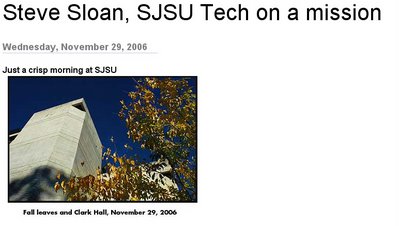
On a side note: thanks to Steve Sloan and everybody else who has been blogging about their safety concerns around Clark Hall.

Steve posted this picture on the 25th; apparently administration listened to people's concerns and acted appropriately. As Steve wrote, "That is a win for everybody!"

Speaking of Steve, JMC 163 is coming to a close soon. For those of you not attending SJSU, it's a new media class (one of the very, very few) that explores both the theory and applications that allow new media to flourish. The class drew much attention from all over the world earlier this year when SJSU banned Skype's use on campus.

This media attention gave students like myself the opportunity to experience google bombs, Web 2.0 realities, and bureaucracy, firsthand.


It's also brought many a powerful speaker to the class, including famous authors like David Weinberger, famous bloggers like Phil Wolff from Skype Journal, and famous vloggers like Ryan Hodson from Node 101 (and everywhere else). And that's just to name a few!

It's great to see that some teachers and administration officials are realizing that these are the leaders of tomorrow's technological boom - the forerunners of a new media industry.

I seriously hope for the future of both SJSU and the economy that the University encourages such classes next semester and for years come, as it is a priceless asset. Steve already said it best, so I'm going to steal from him now and go out on top:

Most importantly our students have gained valuable skills and more. They have gained insight into the global "new media" conversation (often called "Web 2.0") that is going on and how the media landscape is changing and why things will never go back to being the same as they were in the past.

That is what we did with this "blank slate" and I think our students will be better equipped to deal with the real world of emerging "new media" journalism because of it. We did this all without having even a printer in the classroom because frankly, we did not need one. We did not need paper. The class was all out there for the world to see on the student blogs and the world listened. That is the coolest part, the world listened.

, , , , , ,,

Thursday, October 05, 2006

Roger

After much sweat and blood, I finally think I've gotten Roger onto my server. Here goes nothing.

It is a DivX movie, but you should be able to play it just fine in Quicktime. Enjoy!

, , , , , ,

Saturday, September 30, 2006

Campus Movie Fest Shoot

My group just finished filming for Campus Movie Fest last night at about 8:00 pm. Lots of fun. I'll post our movie from team "JMC 163"as soon as we're done with the editing; I'm pretty sure it'll get some play on YouTube.

It's called Roger, and it's a mockumentary on a small town that's sent a special forces officer from the Department of Homeland Security to "clean up the terrorist scum" that's waiting to attack. Thanks to Jess and her boyfriend for letting us use their place yesterday, and sorry to any passerbys that thought we were killing people.

, , , , ,